There’s a story that’s been circulating online for years. You’ve probably seen some version of it.
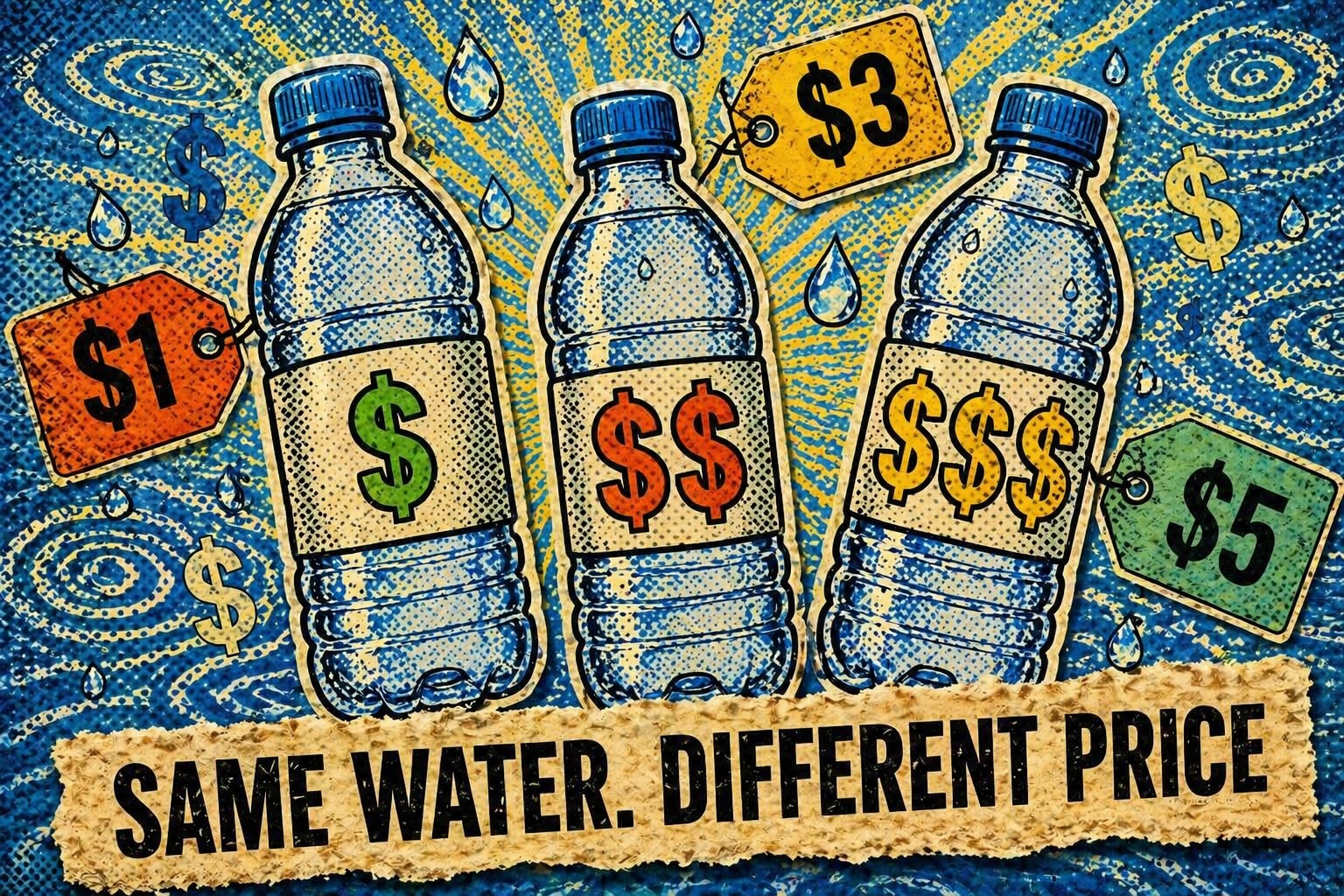
A bottle of water costs $1 at the grocery store, $3 at a convenience store, and $5–$7 at the airport.
Same water. Different price.
At first glance, it looks like a lesson about pricing strategy — charge more, increase margins, move upmarket. But that’s not what’s actually happening here.
The price didn’t change the value. The context did.
Value Is Contextual
Before anyone decides whether something is “expensive” or “worth it,” a set of invisible forces is already shaping their judgment. Context defines what people expect, what they compare you to, how urgently they need you, and how they interpret your price.
In a grocery store, water is abundant. It’s a commodity. Price is the primary differentiator, and buyers treat it accordingly.
At the airport, that same bottle becomes something entirely different — convenient, immediate, necessary. The expectation shifts, and so does the willingness to pay. The product didn’t change. The perception of its value did.
That’s the real lesson. And it applies directly to how your business is being evaluated.
Most Pricing Problems Aren’t Pricing Problems
When a business starts experiencing hesitation from prospects — conversations that drag, decisions that stall, deals that don’t close — the instinct is to look at the price.
So they adjust the number. Rework the offer. Add more deliverables. Try to make it easier to say yes.
And often, nothing really changes.
Not because the price was wrong. Because the positioning was unclear.
Pricing friction is almost always a symptom. The underlying issue is a misalignment between where you’re showing up, who you’re speaking to, and how you’re being perceived. Fix the number without addressing those, and you’re treating the symptom while the real problem continues.
When Positioning Is Unclear, Your Buyer Defines You
If you haven’t clearly established your position in the market, your buyer will do it for you. And they won’t all arrive at the same conclusion.
Some will see you as a transactional vendor. Some will treat you as a considered, strategic decision. Some will evaluate you as a potential long-term partner.
Same expertise. Same track record. Completely different expectations — and completely different price tolerances.
This is why pricing can feel inconsistent or unpredictable. You’re not being evaluated against a fixed standard. You’re being interpreted. And when people are left to interpret, they default to whatever frame of reference is most familiar to them — which may have nothing to do with the actual value you deliver.
The Experience of Being in the Wrong Context
If you’ve felt persistent friction around your pricing, you’ve likely experienced this firsthand.
When you’re in front of the wrong audience, you feel it immediately. You find yourself over-explaining. Justifying your value before anyone’s asked. Educating prospects who aren’t ready to receive it. Hearing “this feels expensive” more than you should.
It’s exhausting — and it erodes confidence. Not just in your pricing, but in your entire approach.
That friction isn’t a sign that your price is too high. It’s a signal that the context is wrong.
What Happens When the Context Is Right
Shift the context, and the dynamic changes — not gradually, but immediately.
When you’re in front of the right audience, conversations get cleaner. Your value is easier to understand. Decisions happen faster. Price stops being the primary point of discussion.
You’re not convincing anyone. You’re not defending your rates. You’re simply being evaluated by people who already understand the category of value you operate in — and that changes everything.
This is the difference between selling water at an airport and selling it at a grocery store. The product is identical. The context determines whether the price feels obvious or outrageous.
The Better Question to Ask
Most business owners respond to pricing pressure by asking: Should I change my prices?
That question assumes the problem is the number. It usually isn’t.
A more useful question is: Am I being seen in the right context?
Because when the context is wrong, everything looks expensive — no matter what you charge. And when the context is right, a premium price feels not just reasonable, but expected.
Why This Becomes Critical as You Scale
This dynamic is especially important for founder-led businesses that have grown primarily through referrals.
In the early stages, referrals do a lot of invisible work. Trust is transferred. Context is inherited. The person referring you has already done the positioning on your behalf — they’ve told the prospect who you are, what you do, and why you’re worth it.
But as you grow and reach new audiences, that built-in context disappears. You’re entering conversations without the warm introduction. You’re speaking to people who don’t have a frame of reference for you yet.
And suddenly, what used to feel effortless becomes harder. Not because your business got worse — because the context changed and your positioning didn’t evolve with it.
The Real Work Is Positioning, Not Pricing
When businesses hit a wall with pricing, they tend to reach for surface-level adjustments — new packaging, restructured offers, discounts, added incentives. These can be useful tools, but they don’t solve the underlying problem.
The real work is defining what you actually do beyond the obvious description, who it’s for and — just as importantly — who it’s not for, how your work should be understood by the people you want to attract, and what role you play in a decision that matters to them.
That’s what shapes context. And context is what determines whether your price lands as reasonable or out of reach.
The Bottom Line
The wrong audience will almost always see a fair price as too expensive. The right audience will recognize your value and expect to pay accordingly.
That’s not a pricing issue. That’s a positioning issue.
Before you adjust your rates, revisit your positioning. Ask whether the people you’re talking to have the context to understand your value — or whether you’re asking them to pay airport prices in a grocery store.
The price isn’t the problem. The context is.