How Vivid Vision and Brand Strategy Guide Boards, Leadership, and Organizational Clarity
At a recent board meeting, a familiar pattern presented itself.
The agenda included all the expected items: reviewing the mission statement, discussing programming priorities, and setting direction for the year ahead. These are standard governance activities, and they matter. But they often lead to circular conversations. Well-intentioned, but not always decisive.
At one point, I suggested something slightly different.
Instead of revisiting the mission statement again, what if we worked on a Vivid Vision?
A vivid vision is not a slogan or a single sentence. It is a detailed description of what success looks like three years from now, a clear, tangible picture of the future the organization is working to create.
That shift, from abstract intention to concrete future state, changes how boards operate.
Because when a board can clearly see the future it is helping to build, governance becomes more focused, more consistent, and ultimately more effective.
From Abstract Mission to Practical Clarity
Mission and vision statements have long been foundational elements of organizational strategy. They provide direction, establish purpose, and signal intent to stakeholders.
But in practice, they often fall short as decision-making tools.
They are too broad to resolve real tradeoffs. Too general to guide prioritization. Too static to influence dynamic conversations.
A vivid vision addresses this gap.
It translates purpose into a lived, observable future. It answers questions such as:
- What does success actually look like in three years?
- How is the organization perceived by its stakeholders?
- What capabilities have been built?
- What has changed as a result of our work?
This level of specificity gives boards and leadership teams something more useful than aspiration. It gives them a shared reference point.
And that reference point changes the nature of governance.
The Reality of Creating Clarity
It is worth acknowledging that developing a vivid vision is not a simple exercise.
In practice, it requires a level of alignment, candor, and vulnerability that many leadership teams and boards are not accustomed to. It often surfaces differing assumptions about the organization’s future, priorities, and identity.
For that reason, the process is rarely resolved in a single discussion. In many cases, it requires dedicated time—often a structured, facilitated session or retreat—to work through competing perspectives and arrive at a shared articulation of the future.
This effort is not a drawback. It is part of the value.
The clarity that emerges is not just the result of writing the document. It is the result of the conversations required to create it.
Governance Becomes a Function of Alignment
When a vivid vision is clearly articulated and actively used, board conversations begin to shift.
Discussions become more focused.
Advice becomes more relevant.
Decisions become more consistent.
Instead of working through issues in isolation, the board can evaluate decisions against a common standard:
→ Does this move us closer to the future we said we want to build?
This question is deceptively simple, but powerful.
It reframes governance from reactive problem-solving to forward-looking alignment. It reduces ambiguity. It creates continuity across meetings and over time.
Most importantly, it aligns the board around outcomes, not just activities.
The Missing Companion: Brand Positioning
A vivid vision, on its own, is necessary, but not sufficient.
It defines where the organization is going. But it does not fully define how the organization shows up along the way.
This is where brand positioning and messaging strategy become essential.
When clearly articulated, often in the form of a positioning framework, messaging guide, or what some organizations call a “playbook”, brand strategy defines:
- What the organization stands for
- How it creates value
- How it is differentiated
- What promises it makes to stakeholders
- What it will and will not do
Together, vivid vision and brand positioning create a powerful pairing:
- The vivid vision defines the destination
- Brand positioning defines the boundaries and identity along the journey
This combination transforms decision-making.
The Governance Litmus Test
When both a vivid vision and a clear brand strategy are in place, boards and leadership teams gain a practical decision framework.
They can ask two critical questions:
→ Does this move us closer to the future we said we want to build?
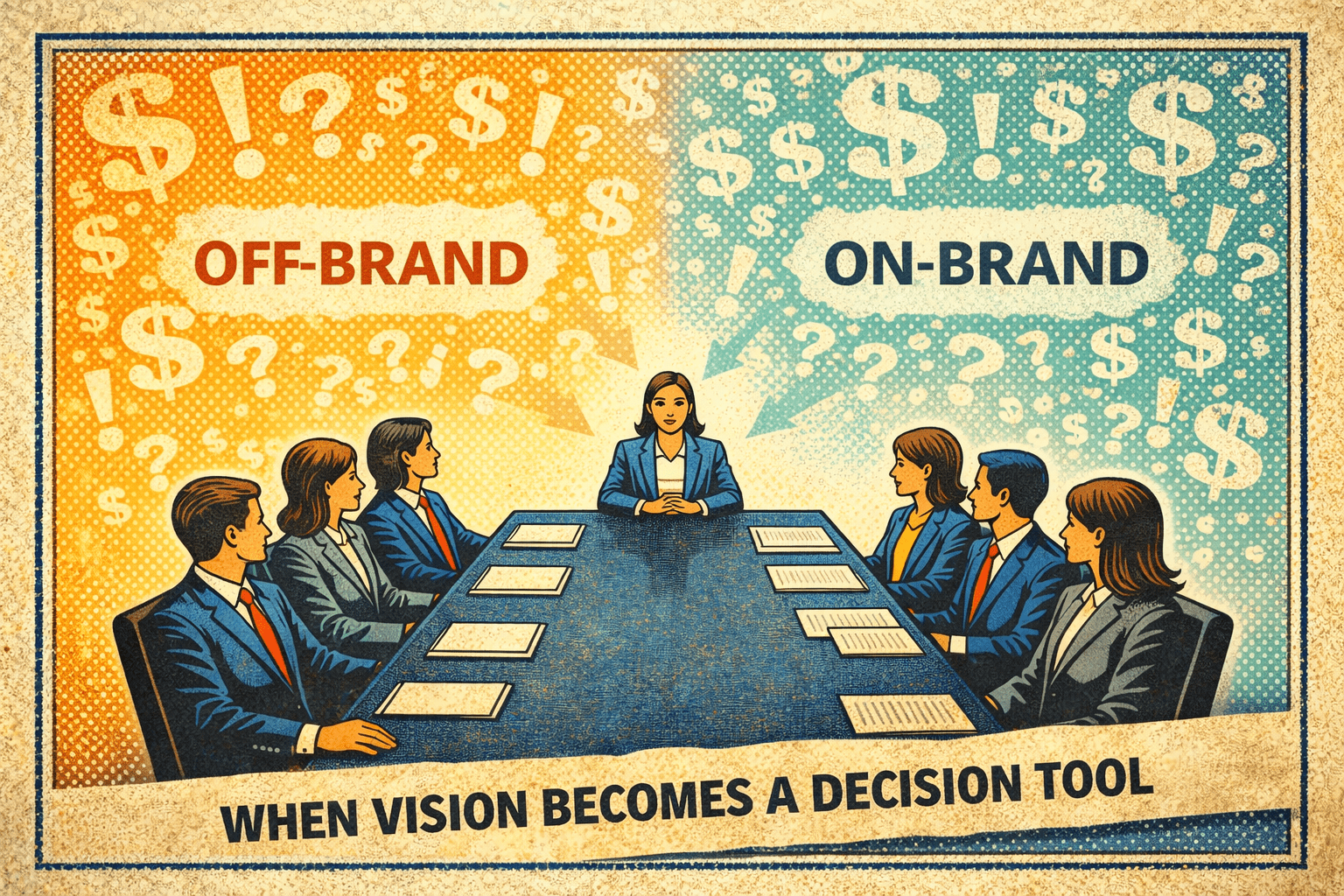
→ Is this on-brand or off-brand for who we are, how we want to be remembered, and how we create value?
These are not marketing questions. They are governance questions.
They apply to:
- New programs and services
- Strategic partnerships
- Resource allocation
- Leadership decisions
- Organizational priorities
Over time, this creates consistency, not through rigid control, but through shared understanding.
It also reduces reliance on individual opinion. Decisions are no longer driven primarily by the loudest voice in the room or the urgency of the moment. They are guided by agreed-upon principles.
This is where Brand begins to function not merely as a communications tool, but as a governance framework.
From Documents to Discipline
It is important to emphasize that neither a vivid vision nor a brand strategy is effective as a static document.
Their value comes from use.
For these tools to remain effective, they must be integrated into the organization’s operating systems. This includes planning, budgeting, and performance evaluation. When decisions about resource allocation, hiring, and priorities are explicitly tied back to the vivid vision and brand positioning, they remain active and relevant. When they are not, they risk becoming aspirational documents that are acknowledged, but not meaningfully used.
A vivid vision only works if it remains part of an active conversation.
Brand positioning only works if it is consistently applied.
Boards that benefit most from these tools do a few things consistently:
- They revisit the vivid vision regularly, not just annually
- They use it to frame discussions and evaluate priorities
- They challenge decisions against positioning and brand principles
- They reinforce these ideas across leadership and organizational culture
Over time, this creates a shift.
The vision is no longer something written down.
It becomes something the organization thinks with.
The Role of Leadership and Day-to-Day Management
While these concepts are often discussed at the board level, their impact is equally important in day-to-day management.
In fact, this is where their influence becomes most visible.
When leadership teams operate with a clear vivid vision and defined brand positioning, decision-making becomes more distributed and more consistent.
Managers and team members are better equipped to make decisions without constant escalation. They understand:
- What success looks like
- What the organization stands for
- What is aligned, and what is not
This reduces friction. It improves speed. It creates alignment across departments that might otherwise operate in silos.
For example:
- A marketing team can evaluate campaigns against positioning, not just performance metrics
- A product or program team can assess new ideas against the future vision
- HR can evaluate hiring decisions based on cultural and strategic alignment
In this way, these tools do more than guide strategy. They shape behavior.
They become part of the organization’s operating system.
Why This Matters for Small Businesses
While the language of governance and board oversight often applies to larger organizations, the underlying principles are equally relevant to small businesses.
In many cases, even more so.
Small business owners and founder-led companies make decisions quickly and frequently. Without a clear framework, those decisions can become reactive, inconsistent, or overly influenced by short-term pressure.
A simplified version of a vivid vision and brand positioning strategy can provide clarity.
It does not need to be complex.
A small business can benefit from:
- A clear description of what success looks like in 2–3 years
- A defined understanding of who they serve and how they are different
- A simple articulation of what is “on brand” and what is not
With even this level of clarity, the same questions apply:
→ Does this move us closer to the business we are trying to build?
→ Is this aligned with how we want to show up in the market?
For small businesses, these questions can prevent costly detours. They help maintain focus. They reinforce differentiation in competitive markets.
Most importantly, they create confidence.
Clarity as a Strategic Advantage
Organizations today operate in environments defined by complexity, speed, and constant change.
In that context, clarity is not a luxury. It is a competitive advantage.
A vivid vision provides clarity of direction.
Brand positioning provides clarity of identity.
Together, they provide clarity of decision-making.
For boards, this means more effective governance.
For leadership, it means better alignment.
For organizations, it means stronger, more consistent outcomes.
A More Practical Approach to Strategy
Strategy is often discussed in abstract terms.
But at its core, strategy is expressed through decisions.
What to pursue.
What to prioritize.
What to say yes to, and what to decline.
A vivid vision and a clear brand strategy make those decisions easier, not just by removing complexity, but by providing a shared lens through which to evaluate it.
When these tools are used well, something subtle but important happens:
Momentum builds.
Not because every decision is perfect, but because decisions are consistent.
And over time, consistency compounds.
Final Thought
Mission statements articulate intent.
Vivid visions describe outcomes.
Brand positioning defines identity.
Together, they create a system for thinking, deciding, and leading.
And when that system is actively used, at the board level, within leadership, and across the organization, it does more than guide strategy.
It shapes the future the organization is capable of building.